
Marx’s Human Essence proved in all revolutions against Nietzsche’s Übermensch class ideology
Leave a comment11/02/2025 by socialistfight
Those who defend the philosophy of Frederick Nietzsche are spouting reactionary nonsense. Nietzsche was Mussolini’s and Hitler’s favourite philosopher. A thorough going reactionary bigot, he was opposed to the “human essence” as Marx defined it, humans are “cooperative co-producers” of wealth; taking from nature what we need for life is our human essence. This rejected the theory of ‘human nature’, that we re all individuals out for our own betterment at the expense of all others, the essential ideology of all class society.
In other words there isn’t a human being on the face of the planet superior to any other. In like manner there isn’t anyone inferior to any other, contrary to Nietzsche’s “Übermensch” reactionary message. We are all different, of course, but that difference should not determine superiority or inferiority politically, materially or socially.

Spartacus is a 1960 American epic historical drama film directed by Stanley Kubrick, written by Dalton Trumbo, and based on the 1951 novel of the same title by Howard Fast. It is inspired by the life story of Spartacus, the leader of a slave revolt in antiquity, and the events of the Third Servile War.
I am Spartacus: 73–71 BCE and Germany 1914
And that principle has been asserted in every serious revolution recorded in human history. Firstly let us look at Rome’s “I am Spartacus” revolution 73–71 BCE. Of course the slave revolution Spartacus led did not have to wait for the 1962 Spartacus movie, a response to the McCarthyite witchhunts of the left post WWII. In Germany in the revolutionary wave of the early 1920s we had a group which took the name.
“I am Spartacus” came from a movie that came out around 1962. At the end of the slave rebellion when Crassus had defeated the slave army, he wanted to know which of the captives was the leader, Spartacus. Each of the slaves then shouted, “I am Spartacus!” in a stunning display of solidarity.
Each of the captured slaves was then crucified along the Appian Way, some 6,000 of them. The last two were Spartacus and a young man, and Crassus forced the two of them to fight each other to the death. Spartacus, not wanting the young man to endure the long and painful death from crucifixion killed him and was then crucified himself.
“The Spartacus League (German: Spartakusbund) was a Marxist revolutionary movement organized in Germany during World War I. It was founded in August 1914 as the International Group by Rosa Luxemburg, Karl Liebknecht, Clara Zetkin, and other members of the Social Democratic Party of Germany (SPD) who were dissatisfied with the party’s official policies in support of the war. In 1916 it renamed itself the Spartacus Group and in 1917 joined the Independent Social Democratic Party of Germany (USPD), which had split off from the SPD as its left wing faction.
“During the November Revolution of 1918 that broke out across Germany at the end of the war, the Spartacus Group re-established itself as a nationwide, non-party organization called the “Spartacus League” with the goal of instituting a soviet republic that would include all of Germany. It became part of the Communist Party of Germany (KPD) when it was formed on 1 January 1919 and at that point ceased to exist as a separate entity.”

The Diggers and Levellers in the English Revolution, 1642-1652
The Diggers and the Levellers: A history of the radical movements the Diggers and the Levellers which sprung up around the English Civil War. Submitted by Steven. on September 12, 2006
The Diggers tried (by “levelling” land) to reform the existing social order with an agrarian lifestyle based on their ideas for the creation of small, egalitarian rural communities. They were one of a number of nonconformist dissenting groups that emerged around this time. Their belief in economic equality was drawn from Acts of the Apostles 4:32, which describes a community of believers that “had all things in common” instead of having personal property.”
The political and social upheaval that resulted from the English Civil War in the seventeenth century [effectively two conflicts between 1642 -1646 and 1647/48] led to the development of this set of radical ideas.
The Diggers [or the ‘True Levellers’] were led by William Everard who had served in the New Model Army. They were opposed to the use of force and believed that they could create a classless society simply through seizing land and holding it in the ‘common good’.
To this end, a small group [initially 12, though rising to 50] settled on common land first at St George’s Hill and later in Cobham, Surrey, and grew corn and other crops. This small group defied the landlords, the Army and the law for over a year. In addition to this, groups travelled through England attempting to rally supporters.
In this they had some successes in Kent and Northamptonshire. Their main propagandist was Gerard Winstanley who produced the clearest statement of Digger ideas in ‘The Law of Freedom in a Platform’ published in 1652. This was a defence and exposition of the notion of a classless society based in secularism and radical democracy
The relatively small group of followers of Digger ideas was never particularly influential and was quite easily suppressed by Cromwell and Fairfax. The most significant of these movements were the Levellers whose revolutionary ideas resonated throughout the succeeding centuries, mostly notably in the demands of the Chartists in the mid nineteenth century.
The Levellers’ ideas found most support in the ranks of the ‘New Model Army’, formed by Oliver Cromwell in 1645 and were largely responsible for the defeat of the Royalist forces led by Charles I, particularly in the decisive Battle of Naseby in June 1645. By the end of the first civil war in 1646 Leveller ideas were particularly influential and culminated in the Putney Debates where ordinary soldiers debated revolutionary ideas with their generals; it was at this series of meetings that Leveller Colonel Thomas Rainsborough argued the case for universal suffrage (and a lot more than that, I suggest):
“I think that the poorest he that is in England hath a life to live as the greatest he, and therefore truly, sir, I think it is clear to every man that is to live under a government ought first by his own consent to put himself under that government.”
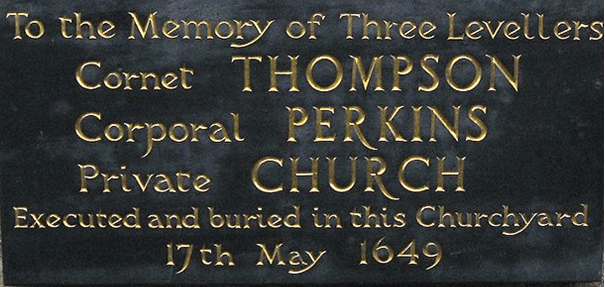
In May 1649 Wikipedia tells is: “Cromwell attacked the “Banbury mutineers”, 400 troopers who supported the Levellers and who were commanded by Captain William Thompson. Several mutineers were killed in the skirmish. Captain Thompson escaped only to be killed a few days later in another skirmish near the Diggers community at Wellingborough. The three other leaders – William Thompson’s brother, Corporal Perkins, and John Church – were shot on 17 May 1649. This destroyed the Levellers’ support base in the New Model Army, which by then was the major power in the land. “Banbury mutineers” opposed Cromwell’s invasion of Ireland.

Francois Noel Babeuf, Also Called Gracchus Or Gracus, 1760.
The French Revolution and the Conspiracy of Equals
The Conspiracy of Equals in the French revolution stood for the same principle. Wikipedia records:
“The Conspiracy of Equals can be seen as the first example of a form of French leftism distinct from that of the Jacobins, more focused upon real equality as opposed to abstract equality in the eyes of the law. Whereas the French Revolutionaries actively sought to guarantee property rights, a guarantee enshrined in the Declaration of the Rights of Man and of the Citizen, Babeuf and his followers desired instead the abolition of property entirely (‘We lean towards something more sublime and more just: the common good or the community of property! No more individual property in land: the land belongs to no one. We demand, we want, the common enjoyment of the fruits of the land: the fruits belong to all’. This criticism of private property put forward by Babeuf and his fellow conspirators would go on to echo through later currents of French leftism: perhaps most pertinently in the thinking of Pierre-Joseph Proudhon, who famously declared ‘Property is theft!’.
£”Although the words “anarchist” and “communist” did not exist at the time of the conspiracy, they have both been used to describe its ideas by later scholars. The English word “communism” was coined by Goodwyn Barmby in a conversation with those he described as the “disciples of Babeuf”.”

The October Revolution 1917
The Bolsheviks’ October 1917 revolution is the most important example. This is a good analysis:
Bolshevik leaders regarded their revolution more or less as just the beginning, with Russia as the springboard on the road toward worldwide revolution. Stalin introduced the idea of socialism in one country by the autumn of 1924, a theory standing in sharp contrast to Trotsky’s permanent revolution and all earlier socialistic theses. The revolution did not spread outside Russia as Lenin had assumed it soon would. The revolution had not succeeded even within other former territories of the Russian Empire―such as Poland, Finland, Lithuania, Latvia, and Estonia. On the contrary, these countries had returned to capitalist bourgeois rule.
“He is an unprincipled intriguer, who subordinates everything to the preservation of his own power. He changes his theory according to whom he needs to get rid of.” Bukharin on Stalin’s theoretical position, 1928.
Despite this, by the autumn of 1924, Stalin’s notion of socialism in Soviet Russia on its own was initially considered next to blasphemy by other Politburo members, including Zinoviev and Kamenev to the intellectual left; Rykov, Bukharin, and Tomsky to the pragmatic right; and the powerful Trotsky, who belonged to no side but his own. None would even consider Stalin’s concept a potential addition to communist ideology.
Stalin’s socialism in one country doctrine could not be imposed until he had come close to being the Soviet Union’s autocratic ruler around 1929. Bukharin and the Right Opposition expressed their support for imposing Stalin’s ideas, as Trotsky had been exiled, and Zinoviev and Kamenev had been expelled from the party. In a 1936 interview with journalist Roy W. Howard, Stalin articulated his rejection of world revolution and said, “We never had such plans and intentions” and “The export of revolution is nonsense”.
We hope these arguments will convince all those serious revolutionary socialists that Nietzsche’s philosophy is reactionary nonsense. ▲



 Socialist Fight