The Warsaw Commune: ‘Betrayed by Stalin, Massacred by Hitler’
Leave a comment16/09/2024 by socialistfight
By Ret Marut

March of the “Brave Lads” unit in front of a Warsaw city centre printers, August 1944 (photo: Sylwester Braun of the Warsaw Rising Museum).
No single event in the history of the Soviet Union illustrates the counter-revolutionary character of Stalinism more than the Warsaw Uprising from August 1 to October 5, 1944. Every strand of Stalinism, that I have encountered over my long years as a Trotskyist from 1977 – CPB (Morning Star), Maoists (followers of Chinese Mao Zedong, Titoist (followers of the Yugoslav Josip Tito) Hoxhaists, (followers of the Albanian Stalinist Enver Hoxha) justifies this appalling act against the Polish and world working class.
I’m aware that some Maoists condemn the Popular Front alliance with the ‘democratic imperialists’ in the imperialist countries but defend the two-stage revolution in the Third World. The correct perspective is the Trotskyist theory of Permanent Revolution; working class consciousness does not develop in a single country but globally. Contrary to the anti-Marxist Stalinist theory of socialism in a single country not only is capitalism not possible in a single country but socialism a hundred time more so. Socialism can only be achieved when the central bastions of imperialism are overthrown, that is today the global hegemonic imperialist power, the US, and all its subordinate imperialists in Europe, Japan, Australia etc.
Unpublished Letter to the Morning Star
I sent the following letter to the Morning Star on August 3:
“The article German president helps mark Warsaw Uprising anniversary (M Star August 3-4) is somewhat economical with the details of what happened there in those 63 terrible days from August 1, 1944. On surrendering on October 5 communists and leftist combatants were immediately executed. Jewish civilians were sent to concentration camps or were mass executed by the Nazis or shipped to Nazi death camps, including Ravensbrück, Auschwitz, and Mauthausen. Many Polish Home Army (PHA) men were also mass executed, although some were sent to POW camps.
“The Red Army’s Eastern Front remained at the (river) Vistula from August 2, and made no attempt to push forward, nor did they deploy their air force to defend the uprising, by far the largest such in WWII; Stalin also rejected Churchill’s offer of air support. About 16,000 Polish resistance fighters were killed and between 150,000 and 200,000 Polish civilians perished, mainly mass executed. During the fighting approximately 25% of Warsaw’s buildings were destroyed. Together with earlier damage suffered in the 1939 invasion of Poland and the Warsaw Ghetto in 1943, over 85% of the city was destroyed by January 1945. The Vistula–Oder Offensive began on 2/1/45 and Warsaw was liberated on 17/1/45 by the Red Army and the First Polish Army.
“Why didn’t Stalin order the Red Army to come to the assistance of the PHA as soon as they had secured the bridgeheads over the Vistula on 2/8/44? War priorities further south was the excuse but, in reality, if the PHA were victorious with Red Army assistance then an independent Poland via a socialist revolution was on the cards. Remember Stalin’s ‘Great Patriotic War’ did not call for a liberating uprising of the German or any working class to defeat Nazism but assigned guilt for fascism to all Germans.”
Will Podmore’s defence
It was not published but one Will Podmore set out the Stalinist defence in the Star on August 5 (online August 2). In 1979 Paul Flewers re-published the 1947 pamphlet by Zygmunt Zaremba, The Warsaw Commune: Betrayed by Stalin, Massacred by Hitler, by Socialist Platform, London, 1997. [1] His long introduction tells the appalling tale in detail and exposes the Stalinist lies, backed up by his conjunctional allies, the ‘democratic imperialists’ and their academic apologists. Podmore reviews the book, How Stalin Won the War by Jonathan Dimbleby but prefers John Erickson’s The Road to Berlin: Stalin’s War with Germany which “remains the best book on the last years of the war” he asserts. [2]
He can cite top imperialist politicians and military commanders who think that Stalin did the right thing (nothing!) during those days while the Nazis slaughtered the Polish resistance. He begins with, “The Red Army was in no position to liberate Warsaw. It had just advanced 724km in five weeks, the longest and fastest advance it had yet achieved. It was at the very limit of its supply lines; troops, ammunition and rations were all exhausted”.
But Flewers tells us: “However, the Soviet forces quickly recovered, and on 8 August the commanders in the field sent plans for an assault upon Warsaw on 25 August to the Soviet Supreme Command for approval. Permission, however, was not forthcoming. Stalin refused to permit Western Allied aeroplanes to land in Soviet-held territory, thus making the provisioning of the insurgents extremely costly… Notwithstanding the very real military difficulties facing the Red Army in an assault upon Warsaw, overall, the behaviour of the Soviet forces cannot be explained by any other factor than Stalin’s wish to see the uprising fail.” His footnote [12] puts the matter beyond doubt. [3]
No co-ordination with Red Army
President Franklin Roosevelt had asked rhetorically: “Do you want me to go to war with Russia?” Churchill, after his initial request to be allowed to assist the uprising with the RAF, quickly came around to Stalin’s viewpoint. And he had the full support of Polish/Soviet General Rokossovsky; “It was a bad mistake. The insurgents started it off their own bat, without consulting us … Let’s be serious. An armed insurrection in a place like Warsaw could only have succeeded if it had been carefully co-ordinated with the Red Army.”
What was the real story? Flewers tells us, “The political outlook and social composition of those involved in the Warsaw Uprising was no secret at the time. Lucjan Blit, a leading member of the Polish Socialist Party (PPS), wrote to Tribune: “I do not know who gave the order to rise. But I do know who forms the overwhelming majority of those fighting for the freedom of my city. It is the Socialist workers from Wola, Powiśle and Żoliborz. It is my comrades from the Smocza Street, who have survived the massacre of the Ghetto. His footnote [17] tells the tale. [4]
Flewers goes on, “The US Socialist Workers Party recognised both the class composition of the Warsaw fighters and their aims: Under the leadership of the great Warsaw proletariat, the Polish masses have fought for five years with unexcelled heroism against Nazi tyranny. They have not taken up arms to exchange one set of oppressors for another. They have not fought for the predatory interests of British imperialism and its Polish henchmen of the London ‘government-in-exile’. Nor have they battled in order to submit to the reactionary rule of Stalin’s bureaucracy and his Polish puppets. They have shown in the course of their tenacious resistance to Hitlerism that they mean to be masters of their own destiny. [5]
“Similarly, the Trotskyists recognised that although resistance movements often mobilised under nationalist slogans, the political content of these movements was considerably more radical: … the widespread Polish resistance movement has adopted a chauvinistic character on its periphery only. Illegal publications that have arrived abroad prove that the illegal movement in Poland in its decisive core is democratically and socialistically-minded. The explanation for this is to be found in the fact that worker cadres form the backbone of the Polish national movement, worker cadres with a rich past of struggles and an old Marxist tradition. [19]” [6]
Stalin’s Great Patriotic War
Of course, the real story is that Stalin’s Great Patriotic War got the support of the ‘democratic imperialists’ only on the basis that both would ensure that the war did not end with great socialist revolutions like October 1917. The crushing of this revolutionary upsurge in alliance with the Nazis and agreed with his imperialist allies was only one of these events. Just the previous year the Italian Communist leader, Palmiro Togliatti , had entered the government as deputy to the turncoat fascist general Pietro Badoglio. Togliatti had already wiped out the Polish communist leadership who were refusing to obey Stalin’s instructions during the Great Purges and had organised the massacre of Trotskyists and anarcho-syndicalists in the Spanish Revolution to appease the ‘democratic imperialists’. With the fall of Mussolini, the huge upsurge in working-class activity saw the collapse of the Nazi puppet Salò Republic in 1945 and large areas of northern Italy come under the control of working-class militias. Togliatti annihilated them all.
There were no Nuremburg trials in Italy; both Stalin and the imperialists needed the fascists to stave off revolution. The French Communist Party was the strongest force within the French Resistance and the CP led the resistance elsewhere and had liberated vast swathes of territory but the Stalinists disarmed these to ensure that the movement was subordinated both militarily and politically to General de Gaulle and the other bourgeois leaders, even though after the Allied landings in 1944, large areas of France, including Paris, were under the control of the resistance militias. The Stalinists accepted de Gaulle’s instructions to dissolve all militias.
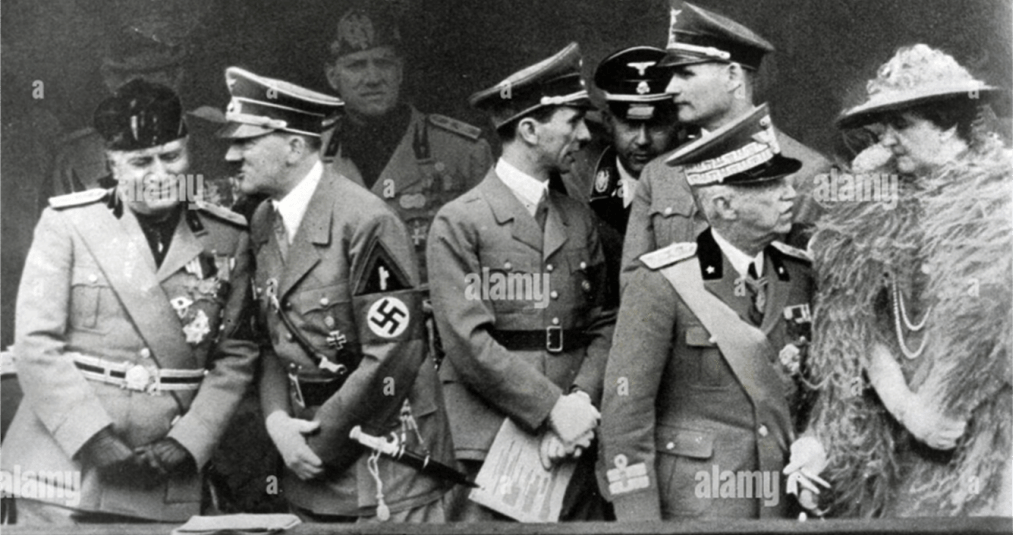
Fascists in Rome, June 1940. From left: Benito Mussolini, Adolf Hitler, Joseph Goebbels, Heinrich Himmler, Rudolf Hess, Marshal Pietro Badoglio and Queen Elena of Italy.
His love of Uncle Joe Stalin
Pathetically Podmore fails to see the very obvious pattern, blinded by his love of Uncle Joe Stalin. He complains:
“Dimbleby fails to mention that in December 1944, Churchill sent 60,000 troops to Greece to crush the Resistance, ordering them to “act as if you were in a conquered city where a local rebellion was in progress … We have to hold and dominate Athens. It would be a great thing for you to succeed in this without bloodshed, if possible, but also with bloodshed if necessary. In the resulting war 158,000 Greeks were killed.”
It seems he does not know that only the oppositionist Tito gave any support to the Greek Communist resistance against Churchill’s forces, much to the annoyance of Stalin. Again, Flewers put the matter straight. “Those who did take up arms, as in Greece, found themselves unceremoniously dumped by the Soviet regime. Stalin did all he could to ensure that the working class would be held in check as the war came to a close.” In the Morning Star, August 14, 15, 28, 31 the 80 years ago today… column by Simon Renton again lyingly re-asserted those old lies from the Daily Worker that the uprising was led by reactionaries; the Red Army was both powerless to assist and right not to try.
Notes
[1] Zygmunt Zaremba 1947, Introduction by Paul Flewers, The Warsaw Commune: Betrayed by Stalin, Massacred by Hitler, https://marxists.architexturez.net/history/etol/writers/zaremba/warsaw-commune/introduction.htm
[2] Morning Star, Will Podmore, review, Endgame 1944: How Stalin won the war, August 5, 2024, https://morningstaronline.co.uk/article/why-red-army-stopped-outside-warsaw.
[3] 12. According to Richard Lukas, the military balance was in the Red Army’s favour. The German forces in and around Warsaw totalled five grenadier and infantry divisions and four panzer divisions, with a total strength of 30 355 men and 341 tanks. The Soviet forces totalled 30 infantry divisions, three or four tank corps, one tank brigade and two artillery divisions, with a total strength of 135 000 men and 670 tanks. In Warsaw and its immediate environs there were 66 000 Soviet troops versus 10 078 German troops, and the Soviet forces had five times as much artillery and 100 more tanks than the Germans. Furthermore, the Soviet Air Force enjoyed air superiority (RC Lukas, ‘Russia, the Warsaw Uprising and the Cold War’, Polish Review, Volume 20, no 4, 1975, p 20).
[4] 17. Tribune, September 1,1944. Around 1000 Jews, who were either survivors from the Ghetto Uprising or had been living in hiding, fought in the uprising. Other nationalities represented were Italians, Hungarians, Slovaks and Russian and other Soviet citizens. Some were living in Warsaw, whilst others had escaped from German prisoner-of-war camps, or had deserted from the German forces. The Warsaw Ghetto, 19 April – 16 May 1943, was the last desperate Jewish stand against the Nazis.. The Nazis say they killed or captured 56,065 and deported some 36,000 to the extermination camps of Majdanek and Treblinka
[5] 18. Militant, 5 August 1944.
[6] 19. A Group of European Comrades, ‘On the Situation in Europe’, SWP (US), Internal Bulletin, Volume 6, no 10, November 1944. Tribune had a better understanding of the resistance movements than the Stalinists. The Daily Worker called the members of the European movements ‘patriots’, but Tribune was far more discriminating, and would emphasise that many resistance fighters were workers and left-wingers. ▲



 Socialist Fight