
On the Philosophy of the Superman
106/05/2024 by socialistfight
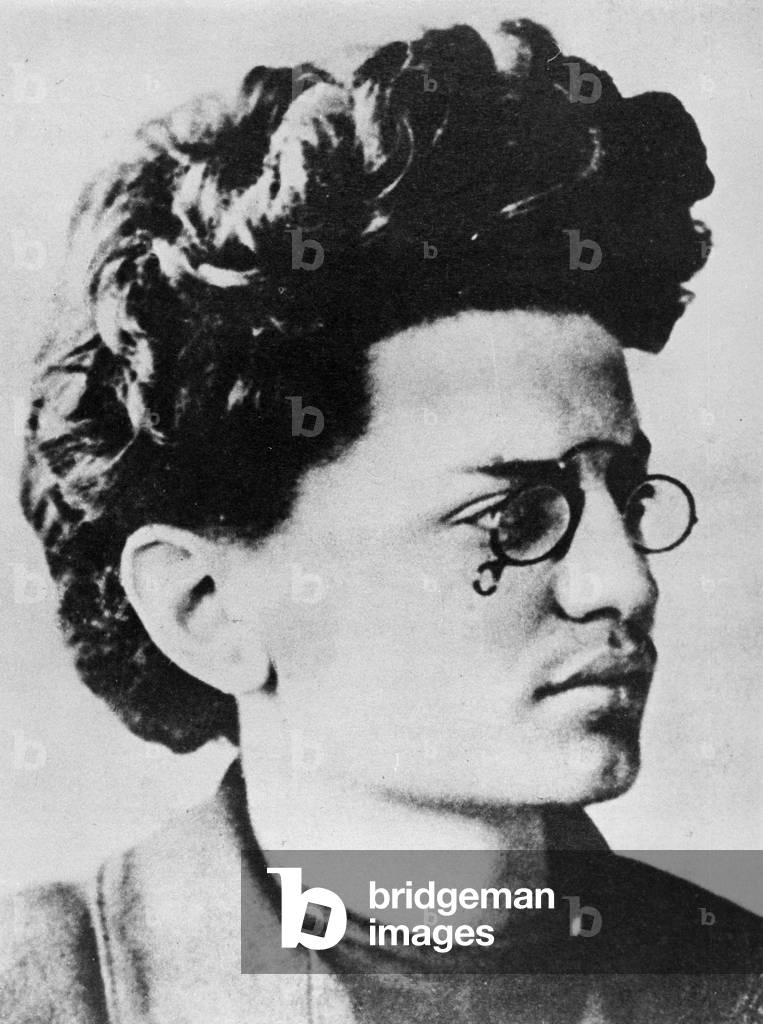
Leon Trotsky 1900 (20 years old, 1879-1940, exiled in Siberia at 18)
These reflections have led us to dedicate a few words to the philosopher Frederick Nietzsche, recently deceased, and in particular to the aspects of his doctrine that concern his concepts concerning and judgments of society, his sympathies and antipathies, his social criticism, and his societal ideal.
For many people Nietzsche’s life and personality explain his philosophy: he could not passively accept the situation his illness placed him in. His forced retirement from public life led him to elaborate a theory that gave him not only the possibility of living under those conditions, but conferred a meaning on that life. The cult of suffering was the consequence of his illness.
You want to annihilate suffering as much as possible and we, it appears, want to increase it, make it stronger than it was. The cult of suffering, of great suffering: is it possible that this cult has led men to the highest summits?[10]
“In these words,” says Alois Riehl[11], “we hear the voice of a sick man who transformed suffering into a means of education of the will.”
But the cult of suffering is only a part, and not one of the most characteristic ones, of Nietzsche’s philosophical system; a part that was rashly put in the forefront by several of our philosopher’s critics and exegetes.
The social axis of his system (if it is permitted to offend Nietzsche’s writings with a term as vulgar in the eyes of their author as that of “system”) is the recognition of the privilege granted a few “chosen” to freely enjoy all the goods of existence.
These happy chosen are not only exempted from productive labor, but also from the “labor” of domination. “It is for you to believe and serve (Dienstbarkeit)! Such is the destiny Zarathustra offers ordinary mortals in his ideal society, whose number is too great”(den Vielvuzielen). Above them is the caste of those who give orders, of guardians of the law, of warriors.
At the summit is the king, “the highest image of the warrior, judge, and guardian of the law.” Compared to the “supermen” all of them are auxiliaries, they are employed in the “rude tasks of domination: they serve to transmit to the mass of slaves “the will of the legislators.”
Finally, the highest caste is that of “masters, of “creators of values,” of “legislators,” of “supermen.” They inspire the activity of the entire social organism. They will play on earth the same role that God, according to the Christian faith, plays in the universe.
Thus even the “labor” of leadership falls not on superior beings, but only on the most elevated among the inferior. As concerns the “chosen,” the supermen,” freed of all social and moral obligations they lead a life full of adventure, happiness, and joy: “Given that I live, “ says Nietzsche, “ I want life to overflow, that it be in me and outside me as prodigal, as luxurious as possible.”
It is a question, above, of the cult of suffering – meaning physical suffering – which no devotion on the part of the slaves can spare the superman. As concerns the suffering tied to social disturbances, the superman, of course, must be absolutely freed from them.
If there remains one mandatory task for the superman, (and this only for the superman im Werden – in the process of becoming) it is that of perfecting himself, which means the elimination of all that might resemble pity. The superman “falls if he allows himself to be dominated by feelings of pity, regret, and sympathy.” According to the former “table of values” pity is a virtue; Nietzsche considers it the greatest temptation and the most frightful danger.
The “gravest sin” according to Zarathustra, the most horrible of misfortunes, is pity. If he feels anything for the unfortunate, if he is touched at the sight of sorrow, his destiny has come to an end: he is vanquished, his name must be crossed from the list of the caste of “masters.” “Everywhere, Zarathustra says, “there resounds the voice of those to whom it is indispensable that death be preached, or eternal life, [he says with an honest cynicism]; which of them is if of no importance to me as long as they disappear (dahinfahren) as quickly as possible.”
Before arriving at the elaboration of his positive ideal, Nietzsche had to submit the dominant social norms in the realms of the state, law and especially morality to criticism. He judged it useful to “re-evaluate all values.” In appearance, what limitless radicalism, what a daring revolutionary idea. Riehl says that “until him no one had analyzed moral values; no one had criticized moral principles.” Riehl’s opinion isn’t isolated, which, it must be said, doesn’t prevent it from being perfectly superficial. More than once humanity has felt the need for a fundamental revision of its ethics, and many thinkers have accomplished this work in more radical and profound a fashion than Nietzsche. If there is something original in his system it’s not the transvaluation of values in itself, but rather the point of view that is at its origin: the will to power, which is at the base of the aspirations, demands, and desires of the superman. This is the criterion for the evaluation of the past, the present, and the future.
But even this is of a doubtful originality. Nietzsche himself writes that in his research into the moralities that dominated in the past and dominate today he encountered two fundamental tendencies: the master’s morality and the slave’s morality. The master’s morality serves as the basis for the conduct of the superman. This dual character of morality traverses the history of humanity like a red thread, and it isn’t Nietzsche who discovered it.
“It is for you to believe and to serve, Zarathustra reminded us, addressing those whose number is too great. The higher caste is that of the “masters, the “creators of values.” For the masters and for them alone, the morality of the superman was created. What novelty, no? Even the landlords during the time of serfdom, who knew little about this subject, knew that there exist people who have blue blood and others who don’t[12] and that what is necessary for one group is reprehensible in the others. Thus they knew, according to the words of the brilliant satirist, that “it was not fitting for a noble to occupy himself with commerce, to have a profession, and to blow his nose without the assistance of a handkerchief, but that it was not inappropriate to gamble an entire village at a game of cards or to trade young Arichka for a hunting dog; that it wasn’t proper for a peasant to shave his beard, to drink tea, and to wear boots.
Nietzsche’s philosophy is not as new as it seems, but it can be considered original to the extent that in order to explain it it is necessary to refer exclusively to the complex individuality of its author. In this case, how can one explain that in such a short span of time it has acquired so many adepts; how can one explain that Nietzsche’s ideas,” in the words of A. Riehl, “have for many become an article of faith?”
We can only do so by stating that the soil in which Nietzsche’s philosophy grew is in no way exceptional. There exist large groups of people who social conditions place in a situation that Nietzsche’s philosophy corresponds to like no other.
Nietzsche became the ideologue of a group living like a bird of prey at the expense of society, but under conditions more fortunate than those of the miserable lumpenproletariat: they are a parasite-proletariat of a higher calibre. The composition of this group in contemporary society is quite heterogeneous and fluid even given the extreme complexity and diversity of relationships within the bourgeois regime. But what ties together all the disparate members of the social order of bourgeois chivalry is the open and at the same time (as a general rule, of course) unpunished pillage on an immense scale of the goods of consumption without any (we insist on stressing this) methodical participation in the organized process of production and distribution.
As the representative of the type we have just outlined we can cite the hero of Zola’s novel “L’Argent, Saccar. Obviously all of the adventurers of finance don’t have the breadth of Zola’s celebrated hero. We have an example on a smaller scale in Stratz’s (bad) novel “Le Dernier Choix” (the translation is available in the collection of Russkoye Bogatsstvo): it deals with a count who gambles on the stock exchange.
But the difference is quantitative and not qualitative. In general there are so many characters of this type in contemporary literature that we don’t know which one to concentrate on.
It should not be deduced from all this that being Nietzschean means being an adventurer of finance or a vulture of the stock market. In fact, the bourgeoisie has spread its individualism beyond the borders of its own class, thanks to the organic ties within society. We can say the same thing relative to the numerous ideological elements of the parasitenproletariat, all of whose members are far from being conscious Nietzscheans. Most of them probably are even unaware of Nietzsche’s existence insofar as they concentrate their intellectual activity on an entirely different sphere; on the other hand, each of them is a Nietzschean despite himself. ▲

Nietzsche, the 19th century Superman. The list of writers and intellectuals influenced by Nietzsche is extensive and looks like a list of who’s who. It includes such high-profile names as Carl Jung, Karl Jaspers, Sigmund Freud, Martin Heidegger, Jean-Paul Sartre, Albert Camus, Ayn Rand, Jacques Derrida, Paul Tillich, Michel Foucault, Hemann Hesse, George Bernard Shaw, and WB Yeats.
All anti-marxists. The list certainly does not include Lenin, Trotsky or any serious Marxist. Problems at work are best tackled in the first place by forming a trade union, not by looking for a superman to do it for you. That is the road to fascism.




 Socialist Fight
Excellent work by Leon Trotsky at 20 years old.
LikeLike