
Letters to the Editor on Transitional Demands
Leave a comment06/12/2023 by socialistfight
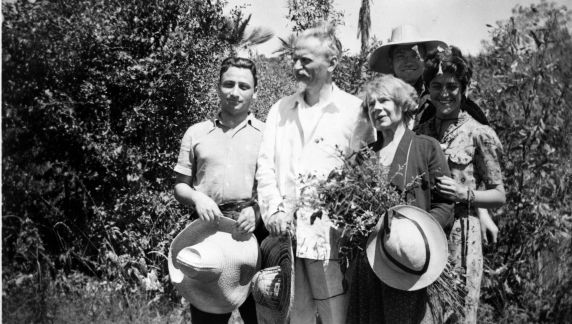
Walter P. Reuther Library (31986) Trotsky, Hansen, Heijenoort, Dunayevskaya, Mexico, 1938
Hi Gerry
I agree with the slogan “for the destruction of the settler-colonial state of Israel”, in a similar way, I am also for the destruction of the UK settler-colonial Northern Ireland regime presiding over its annexed territory. But you kick the solution of Palestine into the indefinite future by relegating it to the achievement of a “Socialist Federation”.
As I have previously claimed, one must study the world-political context in which Trotsky, for example, calls for a Socialist United States of Europe in the late 1930s, i.e., when WW2 was clearly on the agenda. Today, a “Socialist Federation” is a maximum slogan. Why did Trotsky, in 1923, simply demand a United States of Europe, (albeit in a soviet form) i.e., why a transitional slogan in 1923, but a maximum slogan in 1938?
You simply take an easy-way-out by in effect calling for “Socialism Now”, but in a disguised way, i.e., a la the British SWP. One must not reduce program to simply “socialism”. Yes, it’s our program; but we must also address today’s elementary needs and interests of the toiling masses, by not kicking all questions of program into the indefinite future of workers’ states or socialism. Permanent revolution does not, as Bukharin/Radek falsely believed, mean not raising bourgeois democratic demands today, but only socialist demands. You are repeating their leftist conception of permanent revolution.
Yes, some matters will only really be resolved under socialism, e.g., ecology and women’s oppression. I.e., today, we are reduced to, at best, supporting progressive demands on these questions. Hence, ecosocialism is a utopian idea/slogan. Compared to this, socialist feminism understands that only socialism will finally eliminate women’s place as second-class citizens.
Why not femino-socialism instead of eco-socialism? Because both slogans confusedly and deliberately obfuscate the program questions involved. But your answer is in effect to resurrect the minimum/maximum approach to program, by raising the slogan of a Socialist Federation of the Middle East.
This is not an agitational slogan but a subject for propaganda, i.e., part of a more esoteric discussion aimed at the vanguard, and not for the masses. (“many ideas to the few”, rather than “few ideas to the many”.) In other words, one must not remain stuck in propagandism. It is a comfortable place, but the masses must be approached using agitational slogans, and not simply propaganda slogans.
Hence, your slogan for a “Socialist Federation” is a propaganda slogan. The Palestinian, etc., masses must be addressed with agitational slogans and demands. The slogan today must be simply for a United States of the Middle-East; i.e., not with a “socialist” or “workers’ -state” prefix. To insist on your “workers state” prefix is sectarian maximalism disguised as Marxism.
(Incidentally, from my memory, Hansen in early 1954, in a New-York SWP discussion, also argued that “Stalinism is reactionary through and through”. But his later stuff on Cuba in effect corrects this, and is very important.)
Comradely Roy Wall ▲
Hello Gerry
I agree with you to the extent that I understand this matter. Could you expand on how to proceed, from now, to the Multi-ethnic Workers’ State of Palestine in a Socialist Federation of the Middle East. It would be good if you included this matter into the topic of the fight of imperialism for its survival, seeing that its system is not sustainable.
Comradely greetings Marie Lynham ▲

On the Transitional Programme and Method
In reply to Roy and Marie it’s important to stress that we are motivated by our whole programme but what parts of it we emphasise depends on who were are aiming it at. We distinguish between tactics and strategy; we make agitational demands directed at the mass of the working class and propaganda demands on its natural vanguard; the more serious-thinking leaders or potential leaders who look beyond immediate reforms to seek the causes of crises.
So Lenin’s April Theses of 1917, with its crowning slogan, “all power to the Soviets” was directed at the vanguard, Bolshevik leaders and ranks as well as Menshevik Social Revolutionary and anarchists leaders and ranks. And Lenin won that argument against his opponents in April within the Bolsheviks; Kamenev, Zinoviev, Stalin and others, in heated internal meetings and open conferences in those months.
But the Bolsheviks also turned out to the masses with the slogan, “land, bread and peace”. What emphasis they gave to agitation vs propaganda depended on the political situation and the development of the class consciousness of the masses, but these two never became separated completely, as the old German Social Democrats Minimum and Maximum programme were. They believed the Minimum programme was for reforms achievable in the here and now – 8 hour day, paid holidays, sick leave etc. The Maximum was the socialist revolution which thry saw sa objectively developing in capitalist society anyway and did not need human political intervention until the masses called on their leaders to take power.
The Transitional Programme, worked out in the Third Congress of the Comintern in 1920 and developed by Trotsky from that in 1938 made the links between these by putting forward demands which were obviously urgently needed but which capitalism in crisis could or would not deliver. When the working class win some reformist demands its leaders in the trade union bureaucracy and Labour/Social Democratic parties argue that capitalism works and all we need to do is wait until the crisis is over and we can get more reforms.
Revolutionary socialists, on the other hand, argue that the concessions won proves the need to press on with the struggle, capitalism will never solve our problems sufficiently, more concessions will embolden us to ask for more.
On current example is the demand for windfall taxes on energy companies that make huge profits and wealth and steeply progressive taxes on millionaires and billionaires whose fortunes had grown massively in the past half decade and more as the working masses sink deeper and deeper into poverty with the gig economy with foodbanks proliferating. “No, no”, the ultra-lefts shout, “expropriate the capitalists, don’t just tax them more”. But here lies the strength of the transitional method one leads logically to the other, the vanguard of the class will understand this immediately, even if the mass of the class don’t. And Trotsky explains that the road to the development of the class consciousness of the masses vitally is via this vanguard.
Lenin sent Maxim Gorky out to the regions to report back on how the revolution was progressing amongst the masses. He reported that even those sections of the masses with vile racist and anti-semitic social attitudes were supporting the revolution because they understood they were on their side and victory was possible. The outrageously shot a woman hoarding salt who denounced “those old Jews Lenin and Trotsky” for that reason.
So no apologies for raising the demand for a multi-ethnic workers’ state in Occupied Palestine/Israel and for a Multi-ethnic Workers’ State of Palestine in a Socialist Federation of the Middle East at the end of an article which raises all the immediate demands to support the struggles of the Palestinian people even under its social reactionary leaders, Hamas. And lastly the demand for a Socialist United States of Europe vs a demand for a United States of Europe again depends on the stage of the class struggle and class consciousness in emphasis only.
The old Maximum demand for the overthrowal of capitalism in an insurrection to seize state power can only become agitational in a revolutionary situation like October 1917 in Russia. Even then the demand for the convocation of the Constituent Assemble, a transitional demand, was pushed strongly only by the Bolsheviks. That this body proved to be a centre for counter-revolution only became obvious to the vanguard of the class as it began to counterpose itself to the power of the Bolshevik-led Soviets. So they correctly scattered it in January 1918. ▲

Brendan Young, Kildare North, May 22, 2019: “I have been a campaigner for equality for 40 years in Ireland and in the UK. But it was all the more special campaigning locally as an elected councillor for Yes in both the recent Marriage Equality and #Repealthe8th referendums. As a representative we have a duty to stand up for positive change in people’s lives. This Friday I am asking my supporters to turn out to vote ‘Yes’ in the Divorce referendum. People of Celbridge have organised and won great change in recent times – keep going.”
Dear Gerry
A problem with your AIRSG will be persuading its members to adopt the viewpoint of the working class rather than their own individual viewpoints which “come naturally” The Labour-Party question will be an acid test.
Below, are parts of some notes that I wrote for my own self-clarification:
In the 1935 article, “Once Again, the ILP”, Trotsky states, “The Labour Party should have been critically supported [by the ILP] not because it was for or against sanctions, but because it represented the working-class masses.”
Some petty-bourgeois, anarchistic thinkers wish to falsely deny that, today, the LP represents the working-class masses. In essence, by rejecting the dialectical concept of a “bourgeois workers’ party”, they are rejecting dialectics. One comrade, [Brendan Young] who is a PBP [People Before Profits] supporter, is unwilling to understand how Trotsky can claim that the LP represents the working-class masses. “Surely, given that the LP is primarily a bourgeois party, how can it also represent the workers?” The answer is to look at the LP dialectically.
Trotsky repeats his claim that the LP is worker’s party, when he writes, in the same [1935] article as that above, “The war-crisis does not alter the fact that the Labour Party is a workers’ party, which the governmental party is not. Nor does it alter the fact that the Labour-Party leadership cannot fulfil its promises, that it will betray the confidence which the masses place in it.”
Whereas PBP appears to want to give critical support to Corbynite reformism [only], Trotsky is clear that, “Revolutionists never give critical support to reformism, on the assumption that reformism, in-power, could satisfy the fundamental needs of the workers.”
A possible Corbyn challenge to Starmer does not require giving any critical support to reformism. Marxists support the replacement of Stramer by Corbyn. This is because Corbyn is more dangerous than Starmer, and it is necessary for us to help the workers understand that Corbyn’s classical reformism, as-with Starmer’s politics, cannot “satisfy the fundamental needs of the workers”. But PBP wishes to cast illusions about Corbyn by falsely suggesting that [for example] he favoured the “Left Brexit” advocated by it [PBP], the British SP and the British SWP.
Trotsky, in the same article, writes that, “… in war as-in peace, the ILP must say to the workers: ‘The Labour Party will deceive you and betray you, but you do not believe us. Very-well, we will go-through your experiences with you, but in no case do we identify ourselves with the Labour Party programme.’”
In contrast to this approach, left sectarians and anarchists simply wish to denounce the Labour Party, i.e., they do not wish to go-through, with the workers, their experience; but rather, they wish to simply arrogantly talk-down to the workers, …, counterposing their wisdom, i.e., their experience, to the consciousness of the workers.
In August 1940, Trotsky in effect criticised such intellectual arrogance by writing, “We do not oppose, to events and to the feelings of the masses, an abstract affirmation of our sanctity.”
But this, however, is essentially what petty-bourgeois, egoistical, left-sectarian, semi-anarchist intellectuals wish to do. To “events, and to feelings”, they counterpose abstract propaganda. It is a form of “armchair socialism”.
The labour bureaucracy, as a whole, supplies the base on which the LP rests. Ted-Grant-ite sectarians here in Leeds, who arrogantly call themselves “The Marxists”, in effect repeat what the IMG did in the 1970s and later.
They simultaneously adopt a sectarian attitude to the LP whilst, in effect, giving left-cover to the trade-union bureaucracy. This eclectic position is very handy when you have no base among the workers; i.e., Leeds “Marxists” are, as was the IMG, overwhelmingly university students, that is, intellectuals and not workers (to use Trotsky’s distinction).
But it is the trade-union bureaucracy, as part of the labour-movement bureaucracy, which gives-legitimacy- to the LP. This apples to both the left and right wings of the trade-union bureaucracy.
I am guessing that the members of AIRSG are also mostly intellectuals and not workers. In other words, left politics must not be posed a matter of individual consciousness, but of class consciousness.
Tessa Van Gelderen’s sister, Leonora Lloyd, got this wrong despite her wanting to take the LP question seriously. In effect, Pete Firmin does much-the-same. It is not a question of what the individual does, but of what the class and its party should do. And Fred Carpenter’s desire to vote Green, is an expression of his petty-bourgeois individualism, and not of working-class politics.
Comradely Roy Wall ▲



 Socialist Fight