
Postmodern left, Eurasianism and National-Bolshevism (fascism) 13/04/2022
Leave a comment01/07/2023 by socialistfight
Leon Carlos (Bolshevik Militant Tendency), Humberto Rodrigues (Communist League/FCT) and Marcos Silva (Lenin Collective/FCT), respectively, Argentine and Brazilian sections of the Liaison Committee of the Fourth International. First published on May 15, 2015. Updated April 13, 2022.
- Neither postmodern and pro-imperialist lefts, nor “National-Bolshevism”
- For the reconstruction of internationalist Bolshevism!

United States of America, America, US, USA, American vs National Bolshevik Party smoky mystic flags placed side by side.
Postmodernity and imperialist decadence
Postmodernity is the philosophical expression of neoliberalism, which gained strength with the anti-communist offensive with the social counterrevolution in the USSR and Eastern Europe between 1989-1991. Postmodernism is the mortal enemy of any totalizing theory of reality and especially of Marxism.
Neoliberalism was inaugurated in the 1980s, from major defeats of the working class, with the Chilean military dictatorship and the conservative governments of Thatcher in England and Reagan in the USA. Neoliberalism is the economic policy of the new political economy of imperialist financialization, initiated in the 1970s, after the structural turn of the system, which operated the deindustrialization of the West and the transfer of industrial production to China and other Eastern countries.
Thus, postmodernity are socio-cultural trends that emerged mainly in the West that, by different nuances, occurred both in the imperialist centres and in the semi-colonies, with the de-proletarianization of the labor force, privatizations, increase of the service sector, the informal economy and marginalization.
From the crisis of 2008 begins the period of epilogue of postmodernity. The cycle of financialization, of betting on speculation with fictitious capital and its derivatives finds its exhaustion in this crisis of the first decade of the twenty-first century, which had as its epicentre the USA and causes a deep retraction of the participation of the US and the EU in the world market. Industrialization creates in overpopulated China the largest concentration of labor power on the planet and transforms the country into the largest producer of commodities for the world market, under the control of the state planning of the Chinese CP. Simultaneously, Russia, rich in gas and wheat, begins to react to the process of recolonization, statifying the strategic energy and military sectors, consolidating its status as the main supplier of energy to Europe and creating a military sovereignty vis-à-vis the West.
A new cold war is generated from the combination of imperialist decadence and the rise of these two new capitalist powers, whose exceptionality lies in the fact that they were old and immense workers’ states that contradict the imperialist system at a given moment in the process of capitalist restoration. Then, just as the imperialist hegemony of the world system enters into a crisis of domination, albeit at different rates, so too does the dominant economic policy, neoliberalism, and its philosophical expression, postmodernism.
Marxism and Bolshevism
Marxism is the most advanced totalizing and monistic theory of reality. Marxism is materialism fused with dialectics, the most advanced expression of human culture derived from French socialism, German philosophy, and British political economy. These three sources only merged after industrialization and from the proletarianization of the exploited classes in bourgeois society, from the class struggle of the nineteenth century, which laid the foundations of imperialist capitalism and the need to explain it.
The best political expression of this fusion was the Bolshevism created by Lenin, which brought together the revolutionary proletariat for the conquest of power and the foundation of the first workers’ state on the planet in the October 1917 revolution.
Ironically, Gramsci’s teachings are claimed today by national-Bolshevik parties. Sectors of the new global and Brazilian right are technically inspired by neo-gramisanism.
Eurasianism and National-Bolshevism
Revolutionary communism has not re-emerged with the decline of postmodernism, it has not recovered subjectively and organizationally from the great anti-communist ideological offensive wave of imperialism of three decades ago. If revolutionary communism does not currently have the strength, bones and blood to supplant postmodernism materially and subjectively, behold, it arises from a variant of capitalism, born of the national reaction to the neoliberal and neocolonial policy applied to Russia and that empowers itself, that prostitutes communism and its Russian tradition (Bolshevism) and makes a syncretism between the symbols of communism and an old form of bourgeois conservatism, the traditionalism of the Italian Julius Evola.
Not by chance, it is in the accumulation of means of production and destruction – inherited from the workers’ mega-states, which especially in Russia, during the new cold war, that the material bases for the resurgence and projection of reactionary conceptions such as neo-modernism, Eurasianism or fourth political theory (developed by Aleksandr Dugin) and National-Bolshevism (inspired by the Russian politician who died in 2020, Eduard Limonov). The latter is a current born in the first world war in Germany and Russia.
Gramsci had already criticized in his Prison Notebooks what he called “eurasiatism”:
“Eurasianism. The movement revolves around the newspaper Nakanune, which tends to revise the attitude assumed by the emigrant intellectuals: it began in 1921. The first thesis of Eurasianism is that Russia is more Asian than Western. Russia must put itself ahead of Asia in the fight against European dominance. The second thesis is that Bolshevism was a decisive event in the history of Russia: it “activated” the Russian people and boosted Russia’s authority and world influence with the new ideology that it eventually spread. Eurasians are not Bolsheviks, but they are enemies of Western democracy and parliamentarism. They often behave ostensibly like Russian fascists, as friends of a strong state in which discipline, authority, hierarchy predominate over the masses. They are supporters of a dictatorship and welcome the existing state order in Russia of the Soviets, even if they intend to replace proletarian ideology with national one. Orthodoxy is for them the typical expression of the Russian popular character; it is the Christianity of the Eurasian soul.” [1]
Ironically, Gramsci’s teachings are claimed today by national-Bolshevik parties. Sectors of the new global and Brazilian right are technically inspired by neo-gramisanism.
“The neo-Gramscian approach was also developed along somewhat different lines,… Stephen Gill, Research Professor of Political Science at the University of York. Gill contributed to showing how the elite Trilateral Commission acted as an “organic intellectual,” forging the (now hegemonic) ideology of neoliberalism and the so-called Washington Consensus, and later in relation to the globalization of power and resistance in his book Power and Resistance in the New World Order (Palgrave, 2003). [2]
In Brazil, the new military right also tried to make, in its own way, a thorough study of Gramsci, through the study “The Gramscian Revolution in the West”, authored by General Sergio Augusto de Avellar Coutinho, a reference of the extreme right coup plotter, bolsonarist and olavista. [3]
The rise of the new right and Bolsonarism favoured groups that claim Eurasianism, such as the New Resistance group. It also favoured national Bolshevism, such as the Brazilian National Bolshevik Party, PNBB. The PNBB claims as “absolute essence” a meta-ideology between what is common between Bolshevism and fascism. The party also simultaneously claims anti-Semitism and Islamophobia.
Eurasianism also claims traces of Stalinism, orthodox Christianity, fascism and gains some expression with the decadence of imperialist hegemony and its economic, political and philosophical expressions, respectively: financialization, neoliberalism, postmodernism and identitarianism, identified in the East as part of Western decadence.
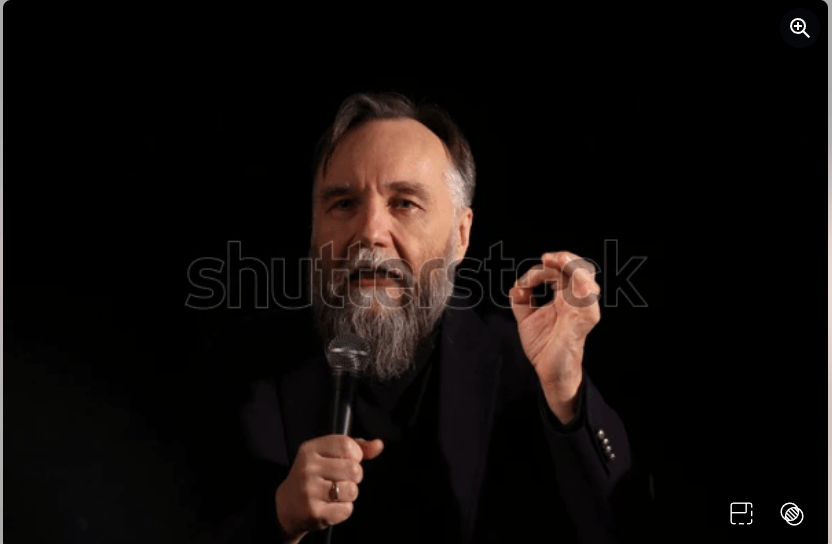
The fascist Aleksandr Dugin in his own words: “The domination of national capital”—this is a Marxist definition of the phenomenon of fascism. It does absolutely not take into account the specific philosophical self-reflection of fascist ideology [and] consciously ignores the fundamental core-pathos of fascism. Fascism—this is nationalism, yet not any nationalism, but a revolutionary, rebellious, romantic, idealistic [form of nationalism] appealing to a great myth and transcendental idea, trying to put into practice the Impossible Dream [sic], to give birth to a society of the hero and Superhuman [sic], to change and transform [preobrazovat’ i preobrazit’] the world.”
The name fourth political theory, which presents itself as subsequent to the theories of liberalism, Marxism and fascism, is a confusing reimagining given by Dugin to Eurasianism. Dugin is falsely presented by a more sensationalist wing of the Western media like Rasputin, Putin’s strategist. The proof that this is a Western myth lies in the fact that Dugin defends the idea that China poses a threat to Russia and stimulates the dispute between the two countries.
In recent years, thanks to the dialectic of the new cold war and especially after the sanctions imposed by Atlanticist imperialism on Russia during the war in Ukraine, Putin has been carrying out an opposite movement, of rapprochement with China, vital in the confrontation between Russia and NATO. But true imperialist think tanks, such as a 2017 study by the Rand Corporation, don’t consider Dugin very influential in the Kremlin or Russian political parties:
“Dugin’s central geopolitical thesis is that because of its unique Asian history and geography, Russia is fundamentally incompatible with the West. Instead, Dugin argues, Russia should seek to dominate the Eurasian space, which he defined as all the republics of the former Soviet Union and some elements of other neighbouring countries. Within this space, Russia must create an environment that promotes “authoritarianism, hierarchy, and the placement of community-based nation-state principles against petty human, individualistic, hedonistic, and economic interests.” Central and Western Europe must fall into an area of German rule, free from the corrupting influence of the “Atlanticist” countries of Britain and the United States. within the sphere of Germany, while Poland, Latvia and Lithuania were to have “special status” within the Russian-controlled Eurasian sphere. Dugin despises the validity of Ukraine as a real country: “Ukraine as a state has no geopolitical significance. It has no particular cultural importance or universal significance, no geographical uniqueness, no ethnic exclusivity.” In addition, China poses a threat to Russia, so Dugin recommends help from Korea, Vietnam, India, and Japan to ensure China’s “territorial disintegration, fragmentation, and political and administrative division of the state.” With the exception of perhaps Ukraine, these do not appear to be realistic concepts that have significant buy-in from Russian officials. He is probably more seen as an extremist provocateur with some limited and peripheral impact than as an influential analyst with a direct impact on politics. He does not appear to have direct involvement with the major parties that advocate aggressive or anti-Western regional policies – such as United Russia, the Communist Party, the Liberal Democratic Party of Russia or Rodina. He was also relieved of his post at Moscow State University after preaching the death of Ukrainian nationalists and harshly criticizing Putin’s policies in Ukraine. (RAND, Russian Views of the International Order, BUILDING A SUSTAINABLE INTERNATIONAL ORDER – A RAND Project to Explore U.S. Strategy in a Changing World, 2017, pp. 81-82).
Even so, one cannot despise political phenomena such as Eurasianism and National-Bolshevism, even more so now when Russia’s victories occur in the conflicts with imperialism. These phenomena attract unwary people who renounce all criticism of the policy of the Russian bourgeois right, they attract the alt-right.
Dugin’s ideas are undoubtedly dangerous and should not be underestimated. That said, it’s noteworthy that Dugin gets far more attention and credibility from figures like Lauren Southern and the Western alt-right than from Kremlin politicians. Dugin fascinates the alt-right with his anti-liberal, anti-globalist, Eurosceptic and nationalist rhetoric. These useful imbeciles, along with reactionary journalists, grant Dugin far greater coverage and legitimacy in the West than in the Kremlin elites, over whom he supposedly wields much influence. As a result, impressionable Western observers conclude that Dugin is an ideological leader when he is not. To truly understand who truly influences the Kremlin, one must look at the Russian Orthodox activist and oligarch Konstantin Malofeev, who funded Russian groups in eastern Ukraine, as well as the early 20th-century Slavophilic philosopher Ivan Ilyin.
In addition to not suffering the influence of Dugin’s fourth theory as they say, Putin also banned the Bolshevik National Party in the Russian Federation, also known as the Nazbol Party (Russian: Национал Большевистская Партия, НБП) founded in 1993 by Limonov, its militants being obliged to found the Other Russia party of E.V. Limonov, which is not registered to participate in elections. The Nazbol Party also sees China as one of the threats to Russia.
The postmodern, identitarian and pro-imperialist left
In turn, the so-called “left NATO” follows the war propaganda of imperialism, that is, the sensationalist media and creator of Russophobic lies to justify NATO’s positions. The “left NATO” reproduces the version that Dugin is Russia’s strategist. The “left NATO” tries to identify Dugin’s ideas about Ukraine as a plan for Russia’s invasion and annexation of all of Ukraine. In its way, this left Favors imperialism by demonizing the goals of the Russian military campaign to “demilitarize and de-Nazify” Ukraine, demanding the sovereignty of the Donbass people’s republics and Kiev’s renunciation of all aspiration to join or collaborate with NATO.
It is necessary to make a materialist analysis of these political phenomena. The contemporary version of Eurasianism is a by-product of a relatively new proletarianization of the international economy. Both for the economic expansion of the Russian Chinese core, and for the need to compete with that of the imperialist powers.
In the absence of a revolutionary direction for the struggles of 1968, their banners were pirated to promote what would become, decades later, postmodernism in cultural identity. This being the leaven of the postmodern and identity left, in the same way that today National-Bolshevism uses anti-imperialist demands to foment the neomodern right.
“Hegel notes in one of his works that all the facts and characters of great importance in the history of the world occur, so to speak, twice. And he forgot to add: the first time as tragedy, the second as farce… Men make their own history, but they do not make it according to their own free will; they do not do so under circumstances of their own choosing, but under those with which they are directly confronted, bequeathed and transmitted by the past. The tradition of all dead generations oppresses like a nightmare the brains of the living. And just when they seem intent on revolutionizing themselves and things, on creating something that has never existed, precisely in these periods of revolutionary crisis, men eagerly conjure up in their aid the spirits of the past, borrowing from them their names, their war cries, and their garments, in order to present and in this borrowed language.” (Karl Marx, 18 Brumaire of Louis Bonaparte).
Therefore, it is not by chance that the neomodern right pirates historical “clothes” of Marxism to camouflage and embellish itself, as a bourgeois ideological shield in its dispute against hegemonic postmodern imperialism. National-Bolshevism is part of the conceptions of the neomodern right that flirts with anti-imperialist groups, that is, of the right that emerges to the same extent that postmodernity enters into crisis. In general, neomodernity can be defined as a sociocultural tendency (which has variables) in which the economic claim prevails, in general, over the cultural identity derived from considerations of race, ethnicity, sex or sexual orientation. With its homophobia and machismo, National-Bolshevism brings together the aspects of a neomodern right.
Momentarily, as in Ukraine, for example, in practical terms we see that the neomodern right has more contradictions with imperialism than the postmodern left that supports the pro-imperialist neo-fascist movement since the Euromaidan coup d’état (2014) and supports the Ucronazis [4] with money and weapons. But we have no doubt that fighting National-Bolshevism (which we detect groups even in Latin American countries like Venezuela) is a challenge for us who, starting from an uncompromising defence of the principles and traditions of Bolshevism and its internationalism, tactically invoke a World Anti-imperialist United Front, without giving up even for a millionth of a second the strategic struggle for new Bolshevik and proletarian revolutions against the bourgeois oligarchies that they control today Russia and China.
The nationalism of oppressed peoples and countries is progressive and legitimate
The internationalists do not despise the national and democratic aspirations nor the patriotism of an oppressed people when in confrontation between this patriotism and imperialism, we consider such aspirations progressive and legitimate, as the Russian reaction to the expansion of NATO. As the founder of the Red Army, created to confront the imperialist coalition, forerunner of NATO, that invaded the USSR during the civil war after the 1917 revolution, taught us:
Chinese patriotism is progressive
“Let us use the example of a strike to clarify the question. We do not support all strikes. If, for example, a strike is called for the exclusion of Negro, Chinese, or Japanese workers from a factory, we are opposed to that strike. But if a strike aims at bettering— insofar as it can—the conditions of the workers, we are the first to participate in it, whatever the leadership. In the vast majority of strikes, the leaders are reformists, traitors by profession, agents of capital. They oppose every strike. But from time to time the pressure of the masses or of the objective situation forces them into the path of struggle.
“Let us imagine, for an instant, a worker saying to himself: “I do not want to participate in the strike because the leaders are agents of capital.” This doctrine of this ultraleft imbecile would serve to brand him by his real name: a strike-breaker. The case of the Sino-Japanese War is, from this point of view, entirely analogous. If Japan is an imperialist country and if China is the victim of imperialism, we favour China. Japanese patriotism is the hideous mask of worldwide robbery. Chinese patriotism is legitimate and progressive. To place the two on the same plane and to speak of “social patriotism” can be done only by those who have read nothing of Lenin, who have understood nothing of the attitude of the Bolsheviks during the imperialist war, and who can but compromise and prostitute the teachings of Marxism. The Eiffelites have heard that the social patriots accuse the internationalists of being the agents of the enemy and they tell us: “You are doing the same thing.” In a war between two imperialist countries, it is a question neither of democracy nor of national independence, but of the oppression of backward non imperialist peoples. In such a war the two countries find themselves on the same historical plane. The revolutionaries in both armies are defeatists. But Japan and China are not on the same historical plane. The victory of Japan will signify the enslavement of China, the end of her economic and social development, and the terrible strengthening of Japanese imperialism. The victory of China will signify, on the contrary, the social revolution in Japan and the free development, that is to say unhindered by external oppression, of the class struggle in China.” [5]
The “NATO left”, which stands against Russia and with NATO and its neo-Nazi puppet that is the Kiev government, is nothing but strike-breakers, as Trotsky said “rompehuelgas”, of the international class struggle. In turn, the patriotism of Russia oppressed by imperialist expansionism and the Russian-speaking people of Ukraine is progressive and legitimate.
Putin’s Neo-Bismarckianism[6] strengthens under imperialist pressure
Putin is a conservative politician, but he is not a fascist and even persecutes the National Bolsheviks in the Russian Federation, as was made clear above. Putin’s Russia, on the other hand, is no longer a semi-colony, controlled by imperialism, as it was shortly after the capitalist social counter-revolution of 1991, but it is also not an imperialist country, it is closer to a dependent country (designation that Lenin gave to Portugal and Argentina in his “Imperialism higher stage of capitalism”), most of its exports are commodities (commodities) and not capital and its GDP is the size of the GDP of the Brazil.
It should be added that Putin’s national and international policy is a kind of neo-bismarquism (O.V. Bismarck carried out German unification after the victory in the war against France in 1871), as seen in his goal of uniting the Russian-speaking peoples within and outside the borders of the Russian Federation. This is progressive in that it does not go against national minorities. Putin’s neo-bismarquism is also seen in the quest for national “cohesion,” in this case against the imperialist powers of the West and Japan.
This neo-bismarquism, insofar as it contradicts the imperialist powers, represents an objective advantage that must be taken advantage of by the Russian and international proletariat and by all the oppressed peoples. But we must not forget its bourgeois and conservative character as seen in the ideological instance of retreat before the Orthodox Church and the bourgeois family. In a broader sense, Putin is seen as the guardian of “security” by Russians, but also by Syrians, Belarusians, Kazakhs, Crimeans, Ukrainian and Serbian people’s republics.
Imperialism has never renounced its Russophobic character. Since the founding of geopolitics by British theorists in the early twentieth century, big world capital has never abandoned its aspiration to conquer the heartland that has Russia as the “geographical pivot of history.”
Putin was thwarted in his aspirations for integration into the group of world powers and excluded from the G-7 that Russia joined between 1997 and 2014, when it was called the G-8. After the neo-Nazi and Russophobic coup d’état of 2014 in Ukraine, Putin was forced to react by retaking Crimea, since then Russia has become the most sanctioned country by the world market controlled by the imperialist system in recent history, only compared to the former USSR. The new and largest wave of sanctions after the beginning of the proxy war in Ukraine, when Russia reacted to the articulations for Kiev’s entry into NATO, has forced Putin to go beyond where he wanted in the policy of rupture with big Atlanticist capital.
Putin has been forced to nationalize international corporations, de-dollarize Russia’s financial and mercantile transactions, create a new payment system outside of Swift, the SPFS, even considering taking back control of the country’s central bank from Russian bankers and the IMF. [7]At this point, two capitalisms clash, that of the decadent imperialist financialization, of finance capital and its derivatives, and the ascendant of commodity production and the so-called real economy:
Andrei Martyanov summed it up this way: “Only two things define the world: the real physical economy and military power, which is its first derivative. Everything else is derivatives, but you can’t live on derivatives.” The American turbo-capitalist casino believes in its own derived “narrative” – which has nothing to do with the real economy. The EU will eventually be forced by reality to move from denial to acceptance. Meanwhile, the Global South will be rapidly adapting to the new paradigm: the Great Davos Reset was destroyed by the Russian Reboot.” (Pepe Escobar, ‘Rublegas:’ the world’s new resource-based reserve currency). [8]
It is the obligation of the true Bolsheviks not to be confused with Stalinism, gravedigger of the Bolshevik Central Committee that carried out the October Revolution of 1917, gravedigger of the Third International and the USSR as the pole of irradiation of the international revolution, great organizer of defeats. And it is all the more obligatory not to confuse Bolshevism with fascism under the national-bolshevist garb of the new right or fascism in general, the stick of finance and imperialist capital against the working class, mortal enemy of communism and therefore of Bolshevism. Not for a moment must our anti-imperialist struggle for the national emancipation of the oppressed peoples renounce the strategic struggle for the reconstruction of the world party of the socialist revolution (which for some period was the four internationals) with national workers’ and revolutionary sections, of internationalist Bolshevism, of the program that points out: Workers of the whole world, unite!).
Bibliography, Related articles:
Dialectics of the New War of Hungary
Russia and China strengthen mutual defense against imperialism
León Carlos y Humberto Rodrigues
Russian-Chinese Nucleus, Imperialism and the Proletariat
Contradictions that can be advantageous to the cause of the international proletariat
Bolshevik Militant Tendency – CLFI
About “Left Conservatives”
The irrationalism of the new Russian nationalism
Marxist Space – Communist Workers’ Front – CLFI
The West overestimates Aleksandr Dugin’s influence in Russia
George Barros
The West Overestimates Aleksandr Dugin’s Influence in Russia
George Barros
Russian Views of the International Order,
BUILDING A SUSTAINABLE INTERNATIONAL ORDER – A RAND Project to Explore U.S. Strategy in a Changing World
Notes
[1] Antonio Gramsci, Prison Notebooks, Volume III, p. 144, https://tinyurl.com/2k58ytbd
[2] Wikipedia, Neo-Gramscianism, https://en.wikipedia.org/wiki/Neo-Gramscianism
[3] Wikipedia, Olavo Luiz Pimentel de Carvalho[a] GCRB (29 April 1947 – 24 January 2022)[2][3][4] was a Brazilian polemicist, self-proclaimed philosopher, political pundit, former astrologer, journalist, and far-right conspiracy theorist. From 2005 until his death, he lived near Richmond, Virginia, in the United States, https://en.wikipedia.org/wiki/Olavo_de_Carvalho
[4] Dictionary. Open and Collaborative, Home page: Ucronazi, Ukrainian who defends or sympathizes with Nazi ideology, https://www.wordmeaning.org/spanish/ucronazi.htm
[5] Leon Trotsky, On the Sino-Japanese War, (September 1937), https://www.marxists.org/archive/trotsky/1937/10/sino.htm
[6] Neo-Bismarckian: the strategy Chancellor Otto von Bismarck pursued after German unification in 1871. See, Germany’s Neo-Bismarckian Strategy, by Hans Kundnani, https://www.gmfus.org/news/germanys-neo-bismarckian-strategy
[7] Reuters, Alexander Marrow, September 23, 2022, Russia’s SWIFT alternative expanding quickly this year, central bank sayshttps://www.reuters.com/business/finance/russias-swift-alternative-expanding-quickly-this-year-says-cbank-2022-09-23/
Alla Bakina, director of the central bank’s national payment system department, said 50 new entities had joined Russia’s alternative system this year, taking the total number to 440, of which more than 100 are non-residents. “The System for Transfer of Financial Messages has shown expansion this year because more foreign participants have joined,” Bakina told a banking forum in Kazan.
“More participants joined the SPFS in the first half of the year than in all previous years of the system’s existence,” she said. The central bank does not disclose the list of countries whose institutions have joined the SPFS, Bakina said. Some banks in Russia, including units of some foreign financial institutions blocked from exiting by recent Kremlin laws, still have access to SWIFT and can process payments heading overseas. More than 11,000 financial institutions in more than 200 countries and territories use SWIFT.
Sanctions have increased the use of the SPFS and the issuance of Mir bank cards, Russia’s alternative to Visa (V.N) and Mastercard (MA.N), companies that suspended operations in Russia and their cards that were issued in Russia stopped working abroad. Bakina said a third of all bank cards in Russia are now Mir cards.
But Mir – which means ‘world’ or ‘peace’ in Russian – is facing headwinds abroad. Banks in so-called “friendly” countries – Turkey, Kazakhstan, Vietnam and Uzbekistan – have halted Mir transactions after the latest round of U.S. sanctions. Washington included National Card Payments System (NSPK) head Vladimir Komlev on its sanctions list, prompting some foreign banks to withdraw support.
[8] The Cradel.co, Pepe Escobar, April 01 2022 . ‘Rublegas:’ the world’s new resource-based reserve currency
Rublegas is the commodity currency du jour and it isn’t nearly as complicated as NATO pretends. If Europe wants gas, all it needs to do is send its Euros to a Russian account inside Russia. https://thecradle.co/article-view/8638/rublegas-the-worlds-new-resource-based-reserve-currency



 Socialist Fight